
Inside Pesabase
The PESA Bull Case: What Would It Take for the Token to Be Worth Several Dollars?
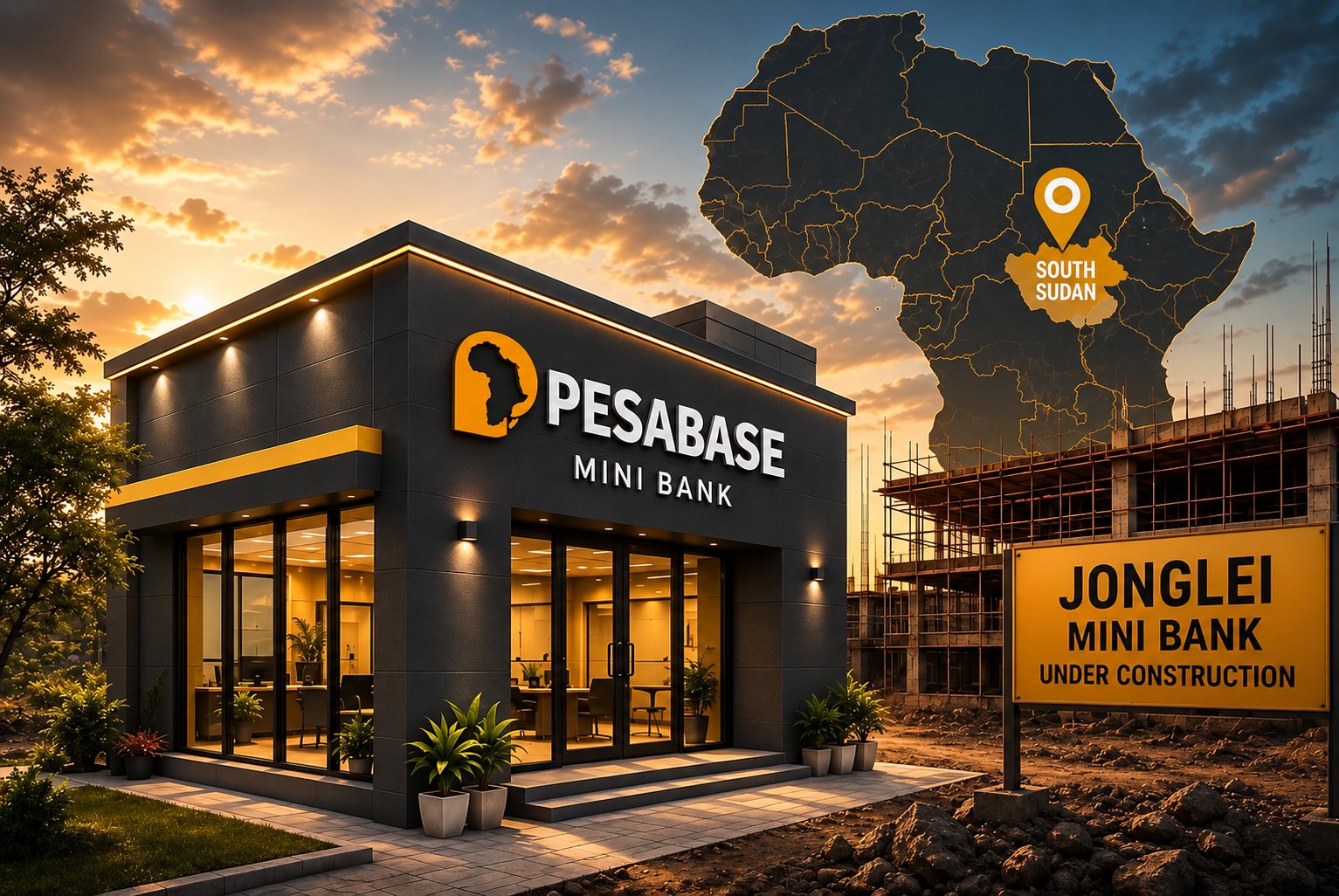 Artist impression
Pesabase’s long-term opportunity is rooted in a real-world financial-services business, not simply a cryptocurrency narrative. If the company can expand its physical network, grow transaction activity and implement its proposed revenue-funded PESA buybacks, the token’s long-term valuation discussion could look very different. None of that is guaranteed. The case depends on execution.
Start with the business, not the token
Crypto projects often speak about financial inclusion, payments and real-world adoption. Far fewer build the operating infrastructure needed to deliver those services consistently. Pesabase is pursuing a model that combines digital payment rails with local agents and physical mini-banks in South Sudan, where access to conventional banking and reliable cash distribution can be challenging.
The company describes its platform as a low-cost remittance and payments service. Customers can initiate transfers digitally, while recipients may access funds through local agents or physical locations. Blockchain infrastructure and a dollar-pegged settlement asset are described as part of the backend process; the customer-facing goal is straightforward: move money and make it accessible in local currency.
That distinction matters. Most customers do not need to understand the technology behind a transfer. They need a service that is available, understandable, dependable and competitively priced.
Why physical infrastructure matters
Digital transfers solve only part of the problem. In cash-oriented communities, the final step—making funds available to the recipient—can be the hardest part. Pesabase’s mini-bank and agent model is intended to bridge that gap by connecting digital payment services with local access points.
The company’s business plan has described an existing operation in Juba and a wider rollout of additional mini-banks. The Jonglei location is an important next test, with Nimule and other locations forming part of the broader expansion ambition. A network of functioning sites could increase geographic reach and transaction capacity, but each location must prove that it can operate reliably and economically.
Send Money With PesaBase
Fast, secure and low-cost transfers to South Sudan.
Become a PesaBase Investor
Discover the PESA token and how it powers the Pesabase ecosystem.
What expansion could mean for transaction volume
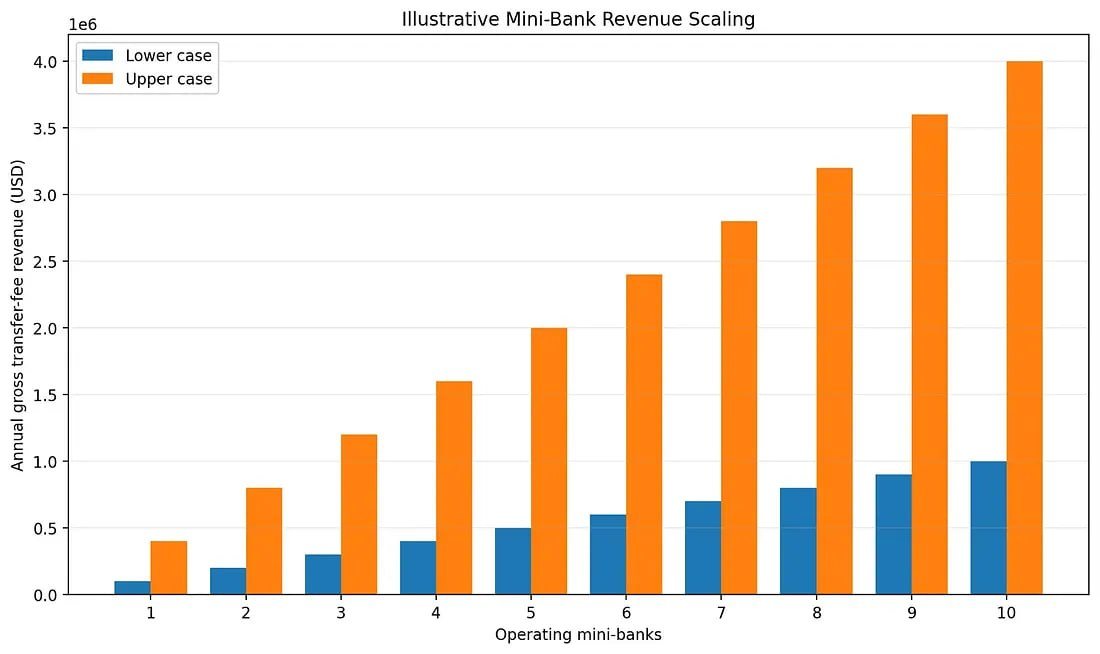
Pesabase’s published business plan has used an indicative range of roughly $10 million to $20 million in annual transaction volume per additional mini-bank, based on the performance assumptions in its plan. If a ten-location network reached that sort of scale, the arithmetic would imply $100 million to $200 million in annual transaction volume. The company has also discussed a target above $150 million once ten mini-banks are operational.
These figures should be treated as company projections, not established outcomes. Transaction volume is not revenue, and revenue is not profit. The economics will depend on actual customer activity, transfer mix, fee levels, operating expenses, cash management, compliance and the ability to keep each location functioning.
The longer-term ambition: a broader financial relationship
Mini-banks may be an important step rather than the final destination. Pesabase’s longer-term plans have referred to a potential licensed banking operation and products such as savings, credit, merchant services, foreign exchange and business financing. Those services could deepen customer relationships and diversify income if the company secures the required approvals, capital and operational capability.
The progression is easy to describe but difficult to deliver: a remittance customer becomes a repeat customer, then potentially a customer for additional financial products. Each stage requires trust, regulatory compliance, sound risk controls and a service that meets real customer needs.
Where PESA enters the picture
The token thesis rests on a proposed economic connection between the operating business and PESA. Pesabase’s published materials have described allocating a portion of company revenue to market purchases of PESA. The plan also describes a fixed supply of 60 million tokens. If the policy is implemented consistently, and if the business grows, those purchases could create a recurring source of demand.
The potential cycle is: more infrastructure, more capacity, more transactions, more revenue and—if the company follows through on its stated policy—more funds potentially available for PESA purchases. This is a thesis to monitor, not a guaranteed mechanism. The actual allocation, timing, scale and treatment of purchased tokens matter.
PESA is not equity in Pesabase. A successful operating company does not automatically make its token valuable, and token holders should not assume they have a claim on company profits or assets. The link between business growth and token demand depends on the published token policies being implemented in practice.
Thinking about dollar-based valuation scenarios
A stated supply of 60 million tokens makes it possible to calculate the fully diluted valuation implied by different hypothetical prices. At $1 per token, the arithmetic is $60 million. At $3, it is $180 million. At $5, it is $300 million, and at $10 it is $600 million.
Those calculations are not price targets. They simply show the valuation attached to each hypothetical token price using the stated supply. The real question is what kind of operating business, revenue base, regulatory standing, customer adoption and recurring token demand might be needed to support those valuations.
A $1 scenario would already require meaningful proof that the company can operate multiple locations and sustain customer activity. A $3 scenario would demand stronger evidence of a scaled network, reliable buyback execution and potentially broader financial services. Higher scenarios would require a substantially more mature business, significant growth and a proven relationship between operating performance and token demand.
Funding and execution are the real tests
Company communications have described funding being secured for the next phase of the mini-bank rollout and capital being directed towards Jonglei. If confirmed and deployed as described, that could ease one constraint on expansion. It does not remove the challenge of completing construction, staffing the location, meeting regulatory requirements, attracting customers and generating sustainable economics.
Leadership presence on the ground may help with coordination across construction, agents, local relationships and operations. It is a positive operational factor to observe, but it is not a substitute for measurable results.
The risks that belong in any honest bull case
South Sudan presents a challenging operating environment. Construction can be delayed; regulatory approvals may take longer than expected; funding plans can change; projected transaction volumes may not materialise; and banking activities require significant compliance and risk-management capability. Competition, foreign-exchange conditions, security, cash logistics and operational costs can all affect performance.
PESA also remains a small cryptocurrency asset. Limited liquidity can amplify price movements in both directions, and market prices may diverge sharply from the progress of the underlying business. Token supply figures and buyback intentions should be checked against current official documentation.
The milestones that matter most
Rather than focusing only on speculative price targets, investors and observers can track concrete milestones: completion and opening of Jonglei; transaction volumes and customer activity at the new site; evidence of operating revenue and costs; progress towards any additional locations; regulatory developments; and transparent confirmation of whether revenue-funded PESA purchases are actually taking place.
The strongest version of the PESA bull case is not that the token must rise because the story sounds compelling. It is that Pesabase could build a meaningful financial-services operation, demonstrate repeatable economics and implement a transparent mechanism linking part of that activity to token demand. Until those results are visible, the thesis remains speculative.
The road ahead
PESA does not need a louder narrative as much as it needs consistent execution. If the company builds, opens, serves customers, reports its results and follows through on its stated token policies, the market will have more evidence on which to assess the long-term opportunity. Jonglei is one of the next important tests.
Disclosure: This article is for informational purposes only and is not financial advice. PESA is a speculative, potentially illiquid cryptocurrency and investors could lose some or all of their capital. Business-plan figures and future plans are company-reported or forward-looking and may change. PESA tokens are not equity in Pesabase.