
Inside Pesabase
PESA's Next Chapter: Market Structure, Liquidity and the Jonglei Milestone

PESA’s market activity has drawn renewed attention, with the token moving into higher trading ranges during the period covered by the original market snapshot. But a rising chart is only one part of the story. Liquidity, the quality of market participation and Pesabase’s ability to advance its physical expansion all matter when assessing what comes next.
Reading a rising chart carefully
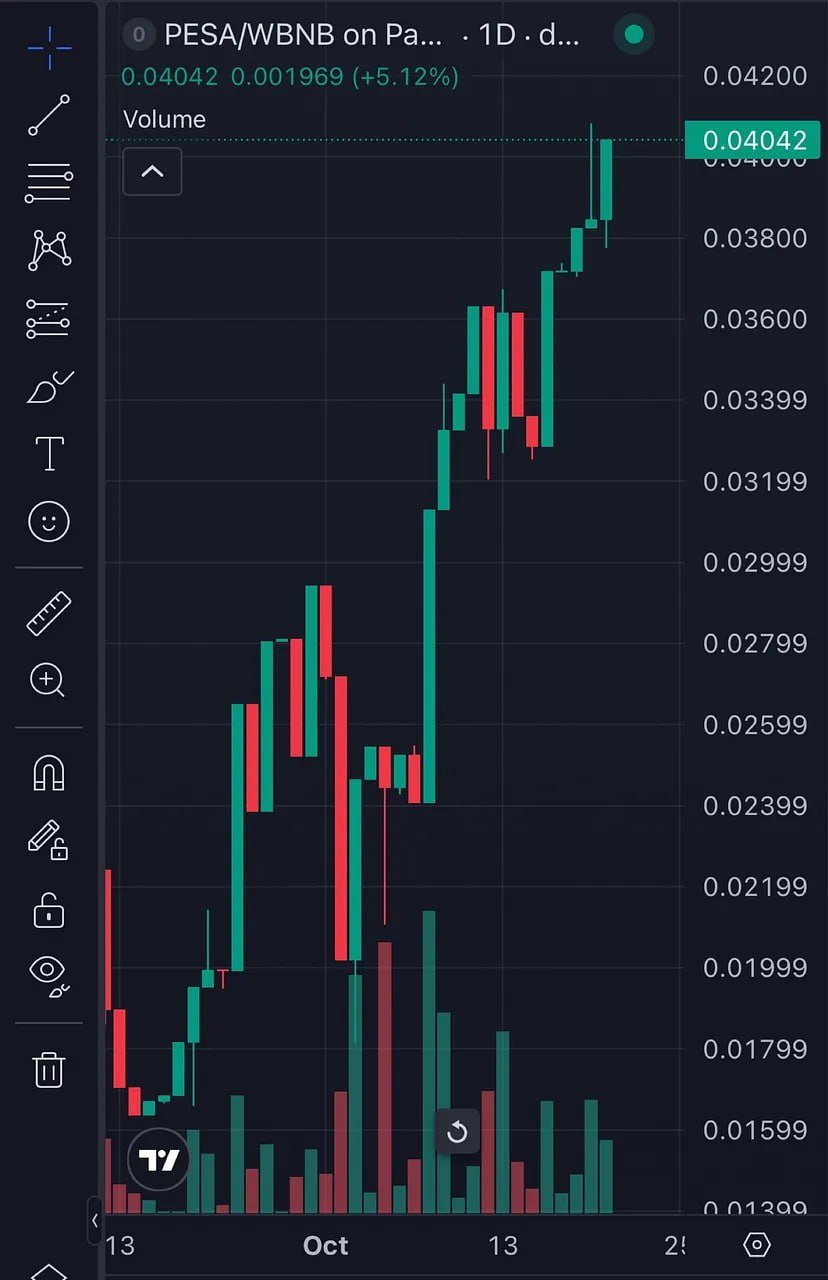
The original article reviewed a move from approximately 1.6 cents to above 5 cents, including a reported level near 5.23 cents on 26 October 2026. It described a sequence of advances, pullbacks and consolidations at progressively higher ranges.
That pattern can be encouraging, but it should not be confused with proof that a lasting support level has formed. A price level becomes more meaningful when the market has tested it through selling pressure and buyers have demonstrated sustained interest. Until that happens, a recent high is simply a recent trading level.
These price references are historical snapshots, not current quotes. Token prices can change quickly, particularly in smaller markets.
Why higher trading ranges attract attention
A market that advances, corrects and then finds buyers at higher levels may suggest improving demand. However, the same pattern can reverse. In a shallow market, a small number of trades can have an outsized effect, and apparent support can disappear if liquidity or sentiment changes.
The more useful question is whether higher levels are accompanied by sustained volume, a broader group of participants and enough liquidity to absorb ordinary buying and selling without extreme price impact.
Send Money With PesaBase
Fast, secure and low-cost transfers to South Sudan.
Become a PesaBase Investor
Discover the PESA token and how it powers the Pesabase ecosystem.
Liquidity is a market-quality issue
The original market snapshot cited approximately $111,000 in total PESA/WBNB liquidity and a displayed market capitalisation of around $3.1 million, implying a liquidity-to-market-cap ratio near 3.6%. It also discussed a proposed additional $60,000 in liquidity, which—if fully deployed under the stated assumptions—would have increased the pool to roughly $171,000.
Those figures were tied to a 26 October 2026 snapshot and project plans at that time. An announced liquidity addition is not the same as a completed deposit, and the final ratio will move as token valuation and pool balances change.
A deeper pool can reduce the immediate price impact of a trade and make it easier for participants to transact. It does not automatically push the price up. Greater depth can moderate the effect of both buys and sells, which is generally a market-structure improvement rather than a directional price signal.
The next important developments are on the ground
The more consequential part of the Pesabase story may be the planned next stage of construction at the Jonglei mini-bank in South Sudan. The original update identified November 2026 as the expected period for construction to resume and February 2027 as the target for the location to become operational.
The Jonglei project is a practical test of whether Pesabase can extend the operating model established in Juba. The coming evidence should include material deliveries, site work, staffing, equipment, local operating arrangements and eventually confirmation that customers can use the facility.
Photographs and progress updates can help demonstrate that work is moving forward, but they do not by themselves prove that the facility is complete, open or profitable. Those stages should be reported separately.

Could business progress influence market confidence?
If the company makes visible progress, publishes useful operating information and demonstrates that the new location can serve customers, investors may have more evidence with which to assess the business. A deeper liquidity pool could also make trading more practical for participants who previously found the market too shallow.
That combination could support greater interest, but it is only one possible outcome. Confidence can change quickly, and operational progress does not guarantee token appreciation. Market demand, broader crypto conditions, liquidity, execution and token policy all play a role.
February and the proposed buyback mechanism
The company has indicated that revenue-funded PESA buybacks are expected to recommence once the Jonglei mini-bank is operational and connected. The underlying idea is that a growing service business may generate revenue, some portion of which could be used to purchase PESA from the market.
For this to become a credible source of token demand, the location must operate, produce revenue and have funds available after costs and other obligations. The company would also need to implement and communicate the policy consistently. Useful evidence would include a clear allocation rule, dated purchase records and transparent reporting.
PESA is not equity in Pesabase, and the operating company’s success does not automatically translate into returns for token holders.
What to watch next
The next few months should be judged through evidence: updated liquidity figures; construction progress at Jonglei; confirmation of the operational launch; actual customer and transaction activity; and verifiable information about any revenue-funded token purchases.
The road ahead
The important question is not whether PESA can reach another short-term price milestone. It is whether the token market can develop alongside a stronger, functioning business. A more liquid market may help, but the lasting test is whether Pesabase turns its expansion plans into reliable financial services and measurable operating results.
Disclosure: This article is informational and not financial advice. Market prices, liquidity and market-capitalisation figures are historical snapshots from 26 October 2026. Planned liquidity additions, construction dates and buybacks are based on project communications and may change. PESA is a speculative, potentially illiquid micro-cap asset and may lose substantial value.