
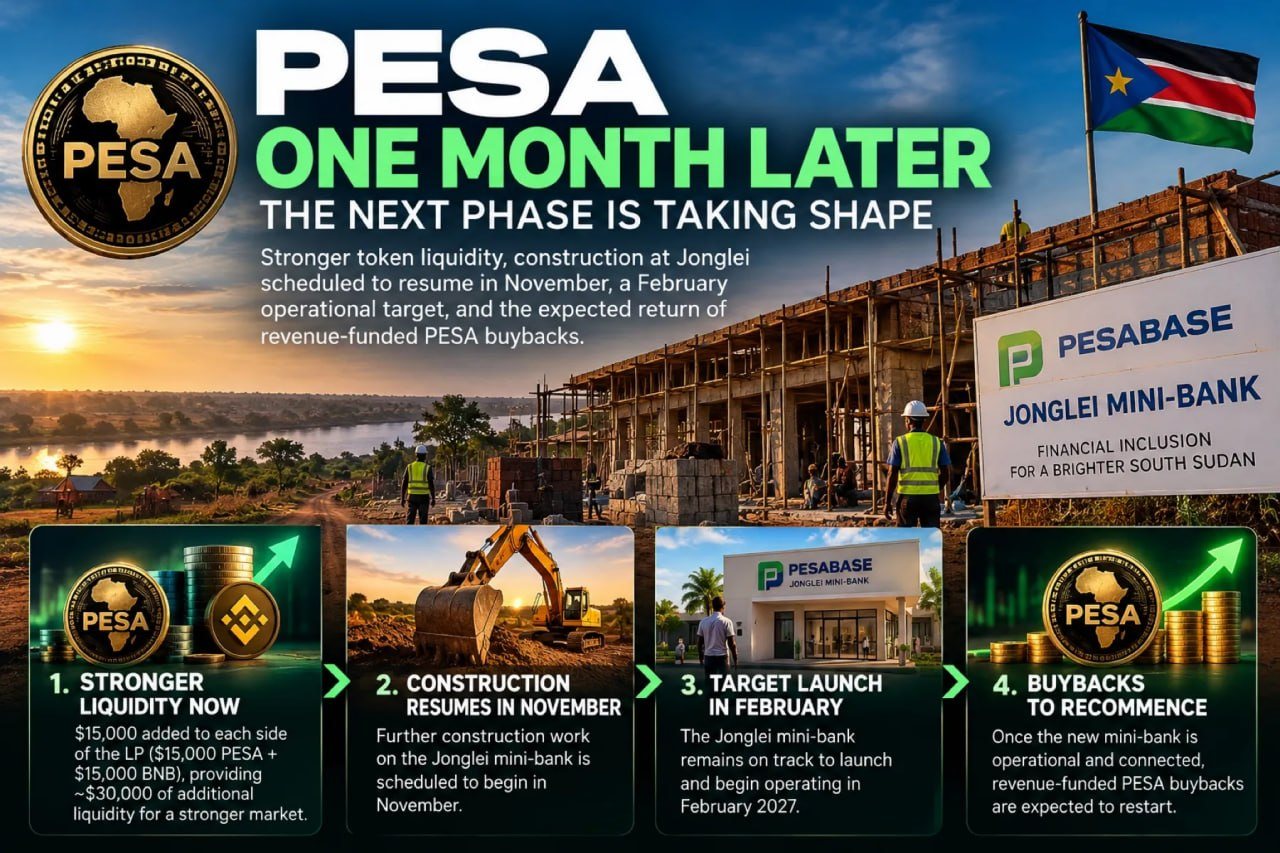
A month after reviewing the longer-term PESA opportunity, several of the developments that could shape the next phase are coming into focus. Reported liquidity additions, preparations for the Jonglei mini-bank and the prospect of revenue-funded token purchases are all worth watching. The key question is whether plans turn into measurable operating progress.
The investment case still comes down to execution
The long-term argument for PESA is not simply about short-term token performance. It depends on whether Pesabase can expand its real-world financial-services operation, increase transaction capacity and demonstrate that business activity can support the token-related mechanisms described in its published materials.
The practical questions remain familiar: can the company bring Jonglei online, can a second location reproduce the operating activity of Juba, can transaction volumes and revenue grow, and will any proposed revenue-funded PESA purchases be implemented transparently? The coming milestones may provide better evidence than market sentiment alone.
Liquidity: a useful improvement, not a guarantee
A liquidity pool is the market depth available to buyers and sellers. In a small token market, shallow liquidity can mean that a relatively modest trade has a large effect on price. Improving pool depth can make trading conditions more workable and reduce the immediate price impact of individual transactions.
Project communications around this period described an intended increase of approximately $15,000 on each side of the PESA/BNB pool—around $30,000 in additional paired liquidity. For a micro-cap asset, that could be material. It should not, however, be confused with the liquidity profile of a large established cryptocurrency.
More liquidity does not guarantee price appreciation. It can reduce the impact of both purchases and sales, and the actual effect depends on how much is deployed, market conditions and trading activity. Investors should distinguish announced additions from funds that have actually been deposited into the pool.
Send Money With PesaBase
Fast, secure and low-cost transfers to South Sudan.
Follow the Jonglei build
Monthly photos and updates in our construction tracker.
Jonglei is the operational milestone to watch
The next major development is outside the token market. Pesabase has described plans to resume the next phase of construction at its Jonglei mini-bank in South Sudan. At the time of the original update, further work was scheduled for November, with February 2027 identified as the target for the location to become operational.
The Jonglei site is important because it can test whether the company’s existing experience in Juba can be extended to another location. Physical infrastructure requires buildings, staff, agents, cash-handling processes, local coordination and reliable links to the digital service. These details are not as visible as a token chart, but they are central to whether the business can scale.
A scheduled restart is not the same as completed construction. The most useful evidence will be dated site updates, material deliveries, work completed, staffing progress and confirmation that the location is ready to serve customers.
Why February matters
The company has identified February 2027 as a target for Jonglei to launch and become operational. If that timetable is achieved, the second location could add capacity and provide a new operating base from which to evaluate transaction activity and unit economics.
The launch date should be treated as a target rather than a promise. Construction, approvals, staffing, equipment and local operating arrangements can all affect the schedule. What matters is not only whether the doors open, but whether the site can deliver a reliable service and generate sustainable activity.
The proposed return of PESA buybacks
A key part of the token thesis is Pesabase’s stated intention to use a portion of business revenue to purchase PESA from the market. Earlier project communications indicated that buybacks were expected to recommence once the new mini-bank was operational and connected.
If implemented, the mechanism could create a relationship between growth in the operating business and demand for the token. The logic is straightforward: more service capacity may support more transactions; more transactions may produce more revenue; and a defined share of revenue could potentially fund token purchases.
The important word is ‘could’. The actual amounts will depend on realised revenue, operating expenses, the percentage allocated, timing and implementation. A public policy, followed by verifiable purchases and regular reporting, would be more meaningful than a general statement of intent.
What larger investors may look for
A deeper liquidity pool may make it easier for larger participants to enter or exit a position, but liquidity is only one factor. Prospective investors may also look for a functioning second location, reliable business reporting, evidence of customer demand, a clear regulatory path and transparent token policies.
Interest from potential investors should not be mistaken for committed capital. Until funds are confirmed and deployed, it is more accurate to describe such interest as a possibility rather than an outcome.
A practical milestone sequence
The next phase can be assessed through a series of observable steps: confirm any announced liquidity additions have been deployed; track construction progress at Jonglei; look for evidence that the location is ready to operate; review transaction and revenue information once it opens; and monitor whether the proposed buyback policy is implemented and reported.
The road ahead
PESA’s story becomes more compelling when the operating business and token market can be assessed using evidence rather than expectations. Stronger liquidity may improve market structure, but the larger test is whether Pesabase can turn its expansion plans into a functioning second location and sustainable customer activity.
Disclosure: This article is informational and not financial advice. PESA is a speculative micro-cap cryptocurrency and may be highly volatile or illiquid. Liquidity additions, construction dates, launch targets, buybacks and investor interest are based on project communications or forward-looking expectations and may change or not occur. PESA is not equity in Pesabase.